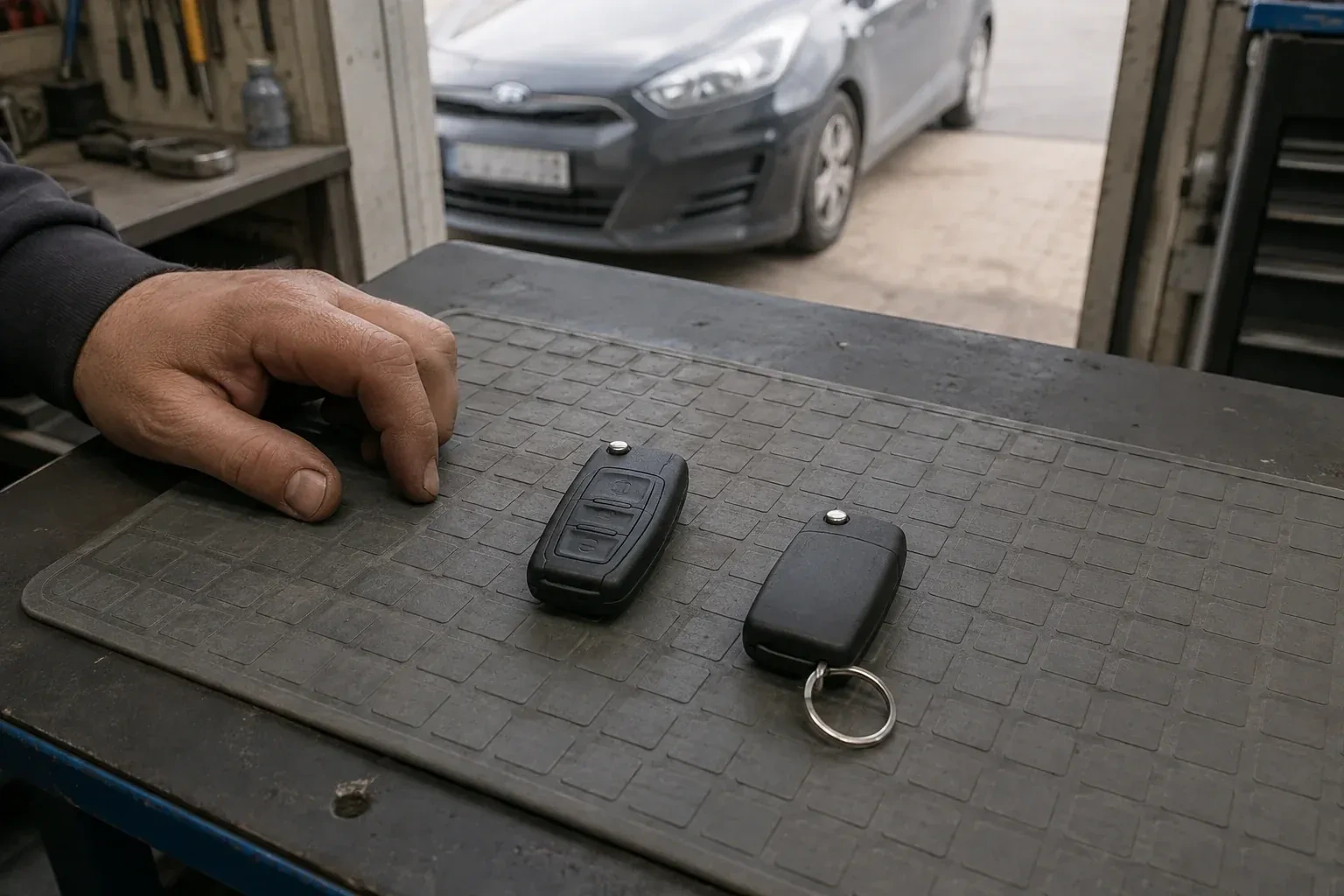
Car keys · Toronto
Key Fob Programming
A cracked case or a spin through the wash left the fob unresponsive, and opening it up reveals a slightly corroded board where the buttons used to sit. The mechanical blade still turns the lock on its own, but the wireless side of the fob has gone silent.
Key Fob Programming
In plain words
A new, unregistered replacement fob is, electronically, a blank slate until it has been matched to one specific vehicle; a used fob is checked rather than assumed the same, since some OEM smart keys become permanently unusable once reset or removed from a vehicle. Programming reads the vehicle's identifying information, confirms the new fob is a compatible part, and writes it into the vehicle's accepted list. From that point the new fob behaves the same as a factory original, answering the same buttons and, where equipped, letting the engine start without the fob leaving a pocket.
How the visit goesA new driver has joined the household, and the one existing fob is the only key anyone has ever had cut for this vehicle. Handing that single fob over for the day means someone else is left without a way into their own car.
Toronto
How the visit goes
Is the new fob actually compatible
Not every fob that looks right for a given maker will actually register onto every vehicle that maker sold. A used or aftermarket fob is checked against the vehicle's identifying information and against what that fob's own hardware supports, since a mismatched chip or the wrong frequency sits unable to register no matter how patiently it is tried. Settling this before ordering parts or beginning the procedure avoids arriving at a dead end partway through, and confirms the household is paying for a fob that will actually work.
Cutting the mechanical backup that hides inside a smart fob
Most proximity fobs carry a small mechanical blade tucked inside the case for the day the battery goes flat or the electronics fail entirely, and that blade is not something the programming procedure creates on its own. Where a replacement fob arrives without a cut blade, or the household wants a spare cut for the glovebox, the key is cut to the vehicle's original code or matched to an existing working key, then tested in the door's mechanical lock the same way any metal key is tested.
A record worth keeping past the visit itself
Vehicles occasionally change hands, insurance occasionally asks questions, and a fob occasionally needs replacing again years down the line, so a simple record of which fobs are registered, when they were added, and which fob was removed if one was lost, saves repeating the same identification work later. Keeping that note with the vehicle's other paperwork, rather than relying on memory, is a small habit that pays off the next time any key work comes up.
Key Fob Programming
In the van
- Vehicle-specific key programmer
- VIN and manufacturer service records
- Replacement or supplied key fob
- Contact cleaner and small brushes
- Precision case-opening tools
What affects the quote
Same fees day, night or weekend
1Condition of the fob already in hand
A fob with a cracked shell, worn buttons or a fading battery may need parts beyond programming alone, and any repair work is priced as its own line rather than folded silently into the visit.
2New fob versus an eligible reused one
A brand-new fob sourced for the visit is priced differently than programming a used or reused fob the household already owns, once that fob has been confirmed compatible with the vehicle.
3How the fob was obtained
A fob purchased new for this specific vehicle, one bought secondhand, or one inherited from a used-vehicle purchase each carry a different starting point, and that history is part of what the quote considers.
Key Fob Programming: questions
What is the difference between a remote, a transponder key and a proximity fob?
A basic remote only operates the locks and alarm from a distance while a separate metal key still starts the engine. A transponder key combines a cut blade with a chip the immobilizer reads before allowing a start. A proximity fob goes further: it authorizes entry while it is nearby, though most vehicles still need the handle touched, gripped or pressed to actually unlock, and it starts the engine with a push button, with no key insertion needed day to day. Each type is programmed differently.
Do all vehicles support passive or proximity entry programming?
No. Passive entry depends on the vehicle being built with the receivers and hardware for it in the first place, not just on the fob being programmed correctly. A vehicle with a basic remote-and-blade key system has no passive entry to program, no matter which fob is registered to it, so the vehicle's own equipment sets the ceiling on what programming can offer.
Will adding a new fob affect my remote start or passive entry?
On many vehicles, no, not for the fobs already working: adding a fob to the accepted list does not change how they behave. Some procedures instead need every retained fob present and re-registered, so check the vehicle's own routine first. Either way, the new fob is tested for every function the vehicle offers, including remote start and passive entry where fitted.
Car Keys
- Car Key ReplacementMinus twenty outside, the fob button does nothing, and the door keyhole has a crust of road salt…
- Spare Car Key DuplicationThe paperwork for the used car changed hands last week, and the previous owner mentioned, almost as…
- Transponder Key ProgrammingThe blade snapped off flush with the door lock last winter, and the shop that cut a replacement…
Key Fob Programming near you
Choose a service to see how it works in Toronto. Each page explains the situation it suits, what the locksmith looks at first, how the job is done, and how to look after the hardware afterwards. If your problem sits between two services, either page will get you to the right conversation.